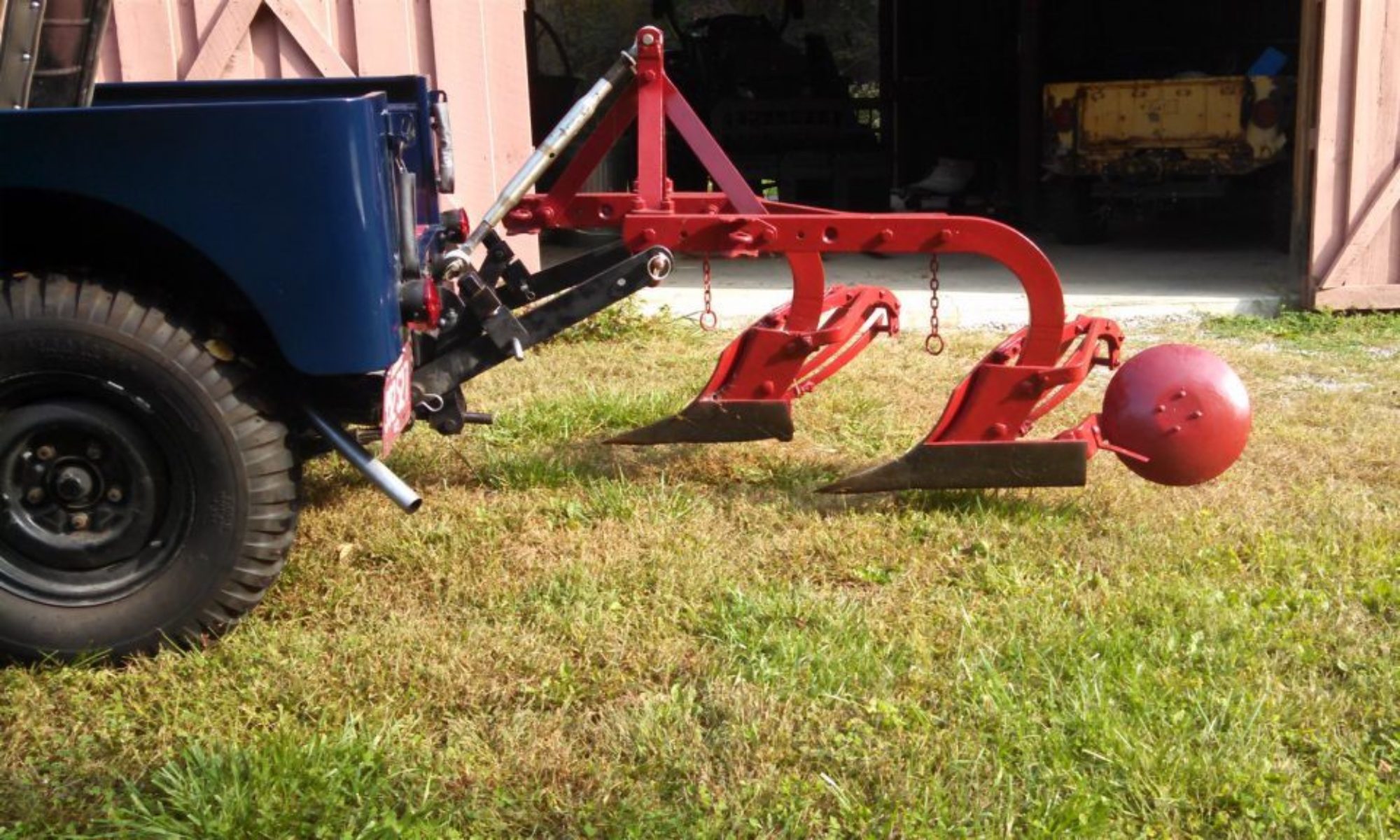

Clint is an anomaly among our Farm Jeep Friends. He doesn’t own a Farm Jeep or any Willys Jeep for that matter, but much of what we know about the Monroe lift and Newgren implements comes from Clint. Luckily for the Jeep world Clint fell in love with a Dodge Power Wagon. It just so happened that Power Wagons could be equipped with Monroe Hydraulic Lifts and Newgren Implements.
Clint has spent years collecting information and writing about the Monroe Auto Equipment Company and the Newgren Equipment Company. As a result, he is our go-to expert and his work and words are visible throughout FarmJeep.com. In addition to helping us restore our Newgren Plow, he authored the Monroe sections of the Dispatcher articles on the history of the farm Jeep.
You can read about Clint’s Power Wagons here. You can also look forward to reading more articles from Clint in the near future.
An interview with Clint
We received a note from Clint: “I was able to go to the Power Wagon Rally for a couple of days in June. Kevin Kaldenbach was there with his family and asked if he could ask some questions and film me. Here is the result” –
Clint’s Monroe Lift Drawings Explained
We asked Clint how he came to produce drawings of the Monroe Lift for the Dodge Power-Wagen:
I purchased my first Power-Wagon in 1980. Soon afterwards, I began collecting literature on the truck and I became vaguely aware of Jeeps being used as tractors from the occasional Jeep literature that I would occasionally find and take the time to read through. It was during the middle 1980’s, after I had accumulated a sizable collection of Dodge literature, when I learned that the Dodge Power-Wagon had also been marketed as a tractor. I found myself thinking about what it might take to convert used Ford N-Series tractor parts (the Ferguson System – three-point hitch linkage components) to function correctly on the back of my truck. I measured all of the parts on the back of my 9N tractor and found the Category I working dimensions in a copy of Appendix I from the second edition of Tractors And Their Power Plants graciously provided to me by Fred Coldwell. I sat down at a manual drafting table and tried to work out the geometry to match the Category I specifications. It was at about this same time that I learned that the 3-point Lifts used the Power-Wagons were produced by one of the same companies who had produced Lifts for the Jeep – the Monroe Auto Equipment Company. I then started finding Monroe literature. Once I saw that the Monroe parts were physically smaller than those used by the Ferguson System, it became clear why my drawings showed that Ford tractor parts, if retrofitted to the back of a Power-Wagon, would fall way outside of the Category I specified working geometry.
I returned to school within a few years to study computer aided drafting. From there, I was hired at an engineering firm in early 2000. We did not produce any products there. We provided only engineering services for other companies. I began as a CAD drafter producing drawings from 3D models that the designers were creating and by 2003 I was promoted to designer. My first task was to learn a new engineering program that many of our customers had only recently began using – SolidWorks. Aside from a rudimentary introduction into 3D modeling during my classes in AutoCAD during school, this was my first real hands-on experience in the 3D design world.
Shortly after, I ran across an incomplete Monroe Lift, only by chance, from talking to a vendor at an antique tractor show. The parts he did have were NOS and he had found these all still strapped to a shipping pallet. We worked out a deal and I bought his parts and immediately started searching for those that I still needed. At the time, I knew of no other Power-Wagon Monroe Lifts in existence. With what I had learned at the manual drafting table, I decided to take it to the next level with the parts I was slowly accumulating.
My employer allowed me to load SolidWoks on my home computer. I quickly started practicing in the new porgram by reverse engineering and modeling the rear of my truck as well as my Monroe parts. I scaled detailed vintage Chrysler photographs to get a rough idea of the required dimensions of the parts that I was still missing and then created assemblies of both together in SolidWorks. From there, I kept tweaking the part models that represented those that I did not already have in order to assure that they appeared as shown in the photographs, but more importantly, to allow the entire virtual lift assembly to not only work within, but to slightly surpass the Category I working parameters where possible. When I was satisfied, and once I had created a full set of engineering drawings from my models, I contracted with a local machine shop to start machining parts that I needed in order to complete a lift for the back of my truck.
Because SolidWorks, 3D modeling, and reverse engineering was all relatively new to me in 2003, I concentrated mainly on the dimensions that would have an effect the working geometry. Even so, I was able to get actual physical dimensions and the overall appearance of the parts well within the ballpark. I tried to keep these simple as I was continually tweaking locations of holes in order to prove everything out. I did not necessarily add draft to all the cast or forged parts nor did I model all of the hidden internal parts of the hydraulic cylinder and other subassemblies.
That is why my drawings of all of the original Monroe parts that I was able to find show only reference dimensions. The outward appearance of the parts were not all modeled perfectly The goal at the time, as far as drawings of my purchased parts, was to give the machine shop drawings to use only for their identification and to aid their assembly into upper levels. At the time I was not sure who would be doing most of the final assembly – the shop or I.
My intention in offering the drawings seen here is to give Monroe Lift owners a visual guide to parts they may be missing and are in the process of searching for. The twenty-one drawings that I have submitted, with the exception of drawing 60931, are about all I have of parts that can be applied to the Jeep. The vast majority of the remainder are unique to the Power-Wagon as well as a few of the parts having also been utilized in Monroe Lift kits destined for Le Roi Centaur tractors, ATC Terratrac tractors, Jeep trucks, and Sheppard Diesel tractors.
I hope these drawings benefit those who may be searching for Monroe Jeep parts by helping them positively identify the parts they desire.