
Warning! AI-generated and Not Verified.
Barney Roos and the Engineering Vision Behind the Farm Jeep
The engineer who helped transform the wartime Jeep into a civilian farm machine
The Engineer Who Helped Create the Jeep
Few individuals shaped the early Jeep as profoundly as Delmar G. “Barney” Roos,
chief engineer of Willys-Overland during the crucial years when the Jeep evolved from a
wartime reconnaissance vehicle into a civilian utility machine.
Roos joined Willys in 1938 after a distinguished engineering career that included work
with Locomobile, Pierce-Arrow, Marmon, and Studebaker. At Studebaker he had already
established a reputation for practical mechanical innovation and efficient engine design.
At Willys he was tasked with strengthening the company’s engineering foundation.
The company had survived bankruptcy but its passenger cars were struggling to compete.
Roos quickly focused on improving Willys’ aging four-cylinder engine.
The Go-Devil Engine
Willys L-134 “Go-Devil” engine
The engine that powered the wartime and early civilian Jeep was the Willys
L-134 “Go-Devil”, a compact 134-cubic-inch four-cylinder.
Roos and his engineering team redesigned major components of the earlier Willys engine,
strengthening the crankshaft and bearings while improving lubrication and cooling.
The result was a rugged and reliable powerplant capable of producing roughly
60 horsepower and strong low-speed torque—exactly what was needed
for a small off-road vehicle.
This engine became the mechanical heart of the Jeep.
Winning the Military Jeep Contract
When the U.S. Army began searching for a lightweight reconnaissance vehicle in 1940,
Willys engineers entered the competition with their prototype known as the
Willys Quad.
The Go-Devil engine gave the Willys prototype a clear advantage. Its higher power
allowed the Jeep to carry heavier loads while maintaining strong off-road performance.
Roos and his engineering team also worked intensely to meet the Army’s strict weight
limits, trimming ounces from nearly every component. The resulting design became the
standardized wartime Jeep, the Willys MB.
More than 600,000 Jeeps were eventually produced during World War II by Willys and Ford,
serving Allied forces around the globe.
Roos Predicts the Farm Jeep
Even before the war ended, Roos was thinking about how the Jeep might be used in
peacetime. In a 1943 interview he suggested that agriculture could become one of
the vehicle’s most important markets.
“It has great possibilities in agriculture where a small farm is involved…”
Roos believed the Jeep could replace several machines on smaller farms,
serving both as transportation and as a portable power unit.
The Civilian Jeep: CJ-2A
Early Willys CJ-2A advertising
When World War II ended, Willys quickly introduced the
CJ-2A (Civilian Jeep) in 1945.
The vehicle retained the rugged drivetrain and Go-Devil engine of the military Jeep
but added several civilian features:
- Tailgate
- Side-mounted spare tire
- Larger headlights
- Improved seating
Willys marketed the CJ-2A as the “Universal Jeep.”
Advertisements showed the Jeep plowing fields, powering sawmills,
and performing dozens of agricultural tasks.
Power Take-Off and Farm Equipment
A key feature of the Farm Jeep system was the use of
power take-off (PTO) equipment.
With a PTO attached to the transfer case, the Jeep could power machinery such as:
- Belt-driven saw rigs
- Water pumps
- Grain threshers
- Corn shellers
- Post-hole diggers
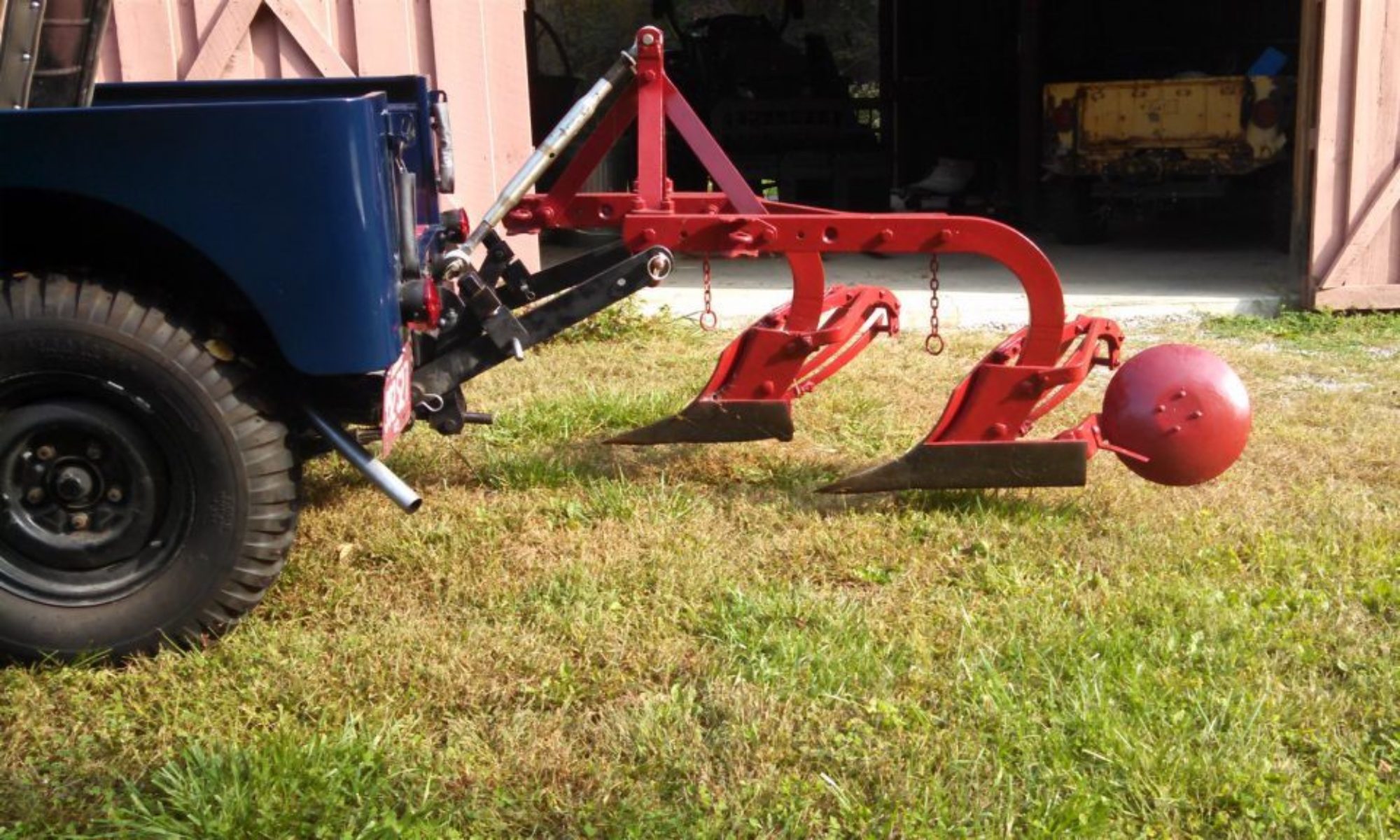
Hydraulic lift systems such as the Newgren lift later allowed implements
to be mounted directly on the Jeep, expanding its usefulness on the farm.
The Legacy of Barney Roos
Barney Roos remained with Willys into the early 1950s as the Jeep line expanded
to include station wagons, pickup trucks, and utility vehicles.
His contributions to the Jeep story were fundamental:
- Engineering the durable Go-Devil engine
- Guiding the Jeep through wartime production
- Recognizing its potential as a civilian farm machine
Today, every restored CJ-2A operating a sawmill or plowing a field reflects
the engineering vision Roos helped create.
Sources
- Dickson Hartwell, The Mighty Jeep, American Heritage, 1960
- Jim Donnelly, “Barney Roos,” Hemmings Classic Car
- Tyrel Linkhorn, “The Brain Behind the Jeep’s Brawn,” Toledo Blade
- Willys-Overland Universal Jeep advertising, 1945–1947