
Sometimes an old advertisement reveals more about the market than the company selling the product.
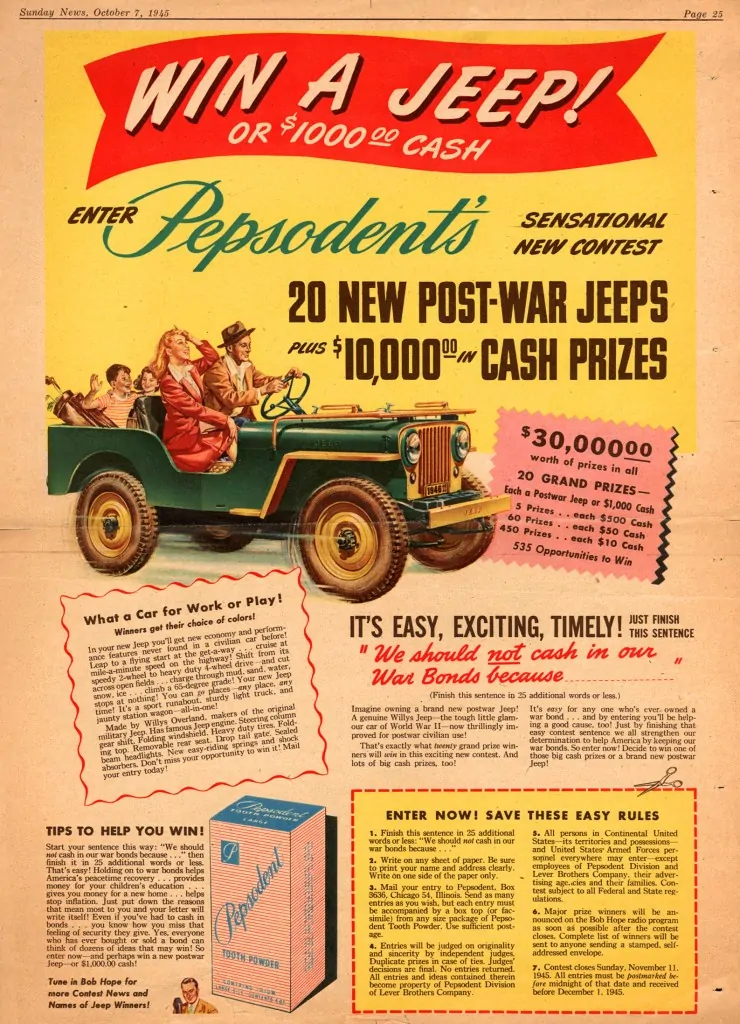
This full-page Pepsodent ad ran on October 7, 1945, less than three months after Willys-Overland introduced the civilian CJ-2A. Prominently across the top was the offer: “WIN A JEEP! OR $1,000 CASH.” Pepsodent offered twenty postwar Jeeps as grand prizes in a promotion tied to Bob Hope’s weekly radio program, along with $10,000 in smaller cash awards. While it looks like standard contest marketing, it offers an interesting look at how the civilian Jeep was viewed during the transition from wartime production to peacetime sales—and it presents a very different picture from the agricultural focus Willys was pushing at the time.
We came across the black-and-white newspaper version of this ad while doing research on Missouri dealerships in 1945. The ad’s Missouri appearance was not a local event. The same layout, or a close sibling of it, ran in The American Weekly — the Hearst newspaper supplement syndicated to member papers nationwide — dated October 21, 1945, and in The Saturday Evening Post that same season. The ad ran in newspapers across the country during October and into early November. A Missouri reader finishing breakfast that Sunday was looking at the same page a reader in Ohio or Oregon might have seen. This was not a regional dealer promotion. It was a national campaign, built around a national radio star, at the exact moment Willys-Overland was trying to convince the American public that the vehicle which had just won a war could now serve them in peace.
The Reach of the Hope Show
To understand what Pepsodent was offering Willys, it helps to put Bob Hope’s audience in terms a modern audience can grasp. The easiest comparison today is the Super Bowl—not merely for the size of the crowd, but for how completely it commanded the culture. During the 1945–46 season, The Pepsodent Show averaged a C.E. Hooper rating of 27.7. In the radio era, that meant over a quarter of all radio-equipped households in the country—roughly nine million living rooms, representing an estimated twenty to twenty-five million listeners—tuned in to Hope every Tuesday night.
Unlike the Super Bowl, which commands the nation’s attention for just one Sunday a year, Hope sustained that level of dominance every seven days across a 39-week season. In our fragmented modern media landscape, where top weekly broadcasts rarely reach five or six percent of the population, that kind of sustained, undivided national attention is nonexistent.
More importantly, Hope carried an immediate connection to the armed services. Throughout the war, his programs aired directly from military bases and hospitals—a routine that continued that autumn with shows staged at Camp Anza, Camp Cooke, and the battleship USS South Dakota. For Willys, having the new CJ-2A featured on that stage meant the civilian Jeep reached roughly one out of every six Americans each week, endorsed by the country’s most trusted military entertainer.
The Clubs in the Back Seat
Look again at the illustration. The Jeep is loaded the way a family car is loaded for an outing — a woman holding her hair in the wind, a man at the wheel, two boys crowded in back — and wedged in among them, unmistakably, a bag of golf clubs. That detail does no work for the contest’s copy. It isn’t mentioned in the rules, and a Jeep pitched as a farm and utility vehicle had no obvious reason to haul sporting goods. It reads as a signature, not an accident: an artist working from an agency brief for the sponsor of The Pepsodent Show had every reason to slip in a wink at the man whose name was printed twice in the same ad.
By October 1945, that wink would have landed. Hope had been telling golf jokes for a decade and a half.
The Contest Structure
The entry process was straightforward: contestants completed the statement, “We should not cash in our War Bonds because…” in 25 words or fewer, enclosed a Pepsodent box top, and mailed it to Chicago. The twenty grand prize winners could select either a new CJ-2A or $1,000 in cash. Five $500 prizes, sixty $50 prizes, and 450 $10 awards rounded out the pool.
The trade publication Broadcasting billed this as Pepsodent’s first major postwar contest. The prompt itself captured the national mood: encourage citizens to maintain wartime financial discipline, with a modern utility vehicle serving as the incentive.
The Illustration vs. The Farm Jeep Pitch
For those interested in early civilian Jeep history, the artwork is the ad’s most telling element.
There is no farmer, no plow, no drawbar, no PTO, and no mud. Instead, the illustration shows a clean, bright green CJ-2A carrying a family on an outing. The caption reads, “What a Car for Work or Play!”
Willys-Overland’s own marketing in late 1945 focused heavily on utilitarian value. At events like the Toledo “Jeep Day” in July 1945, Willys demonstrated the CJ-2A plowing, harrowing, and powering belt-driven farm machinery, pitching it as a practical replacement for light tractors and utility trucks. While Pepsodent’s body copy mentioned four-wheel drive, the tailgate, and bad-weather capability, the accompanying image skipped the field entirely and instead depicted recreational family transportation.
Establishing the Willys Brand
Willys faced an identity challenge in late 1945. While the public was thoroughly familiar with military jeeps, both Willys and Ford had manufactured them, and Willys was actively working to secure “Jeep” as its exclusive trademark.
The ad’s fine print addressed this directly: “Jeep built by Willys Overland, makers of the original military Jeep.” This was straightforward brand positioning. By pairing with a major consumer sponsor, Willys gained national exposure that reinforced the connection between the Willys name and the civilian model, without carrying the full cost of a standalone advertising campaign.
Work or Play
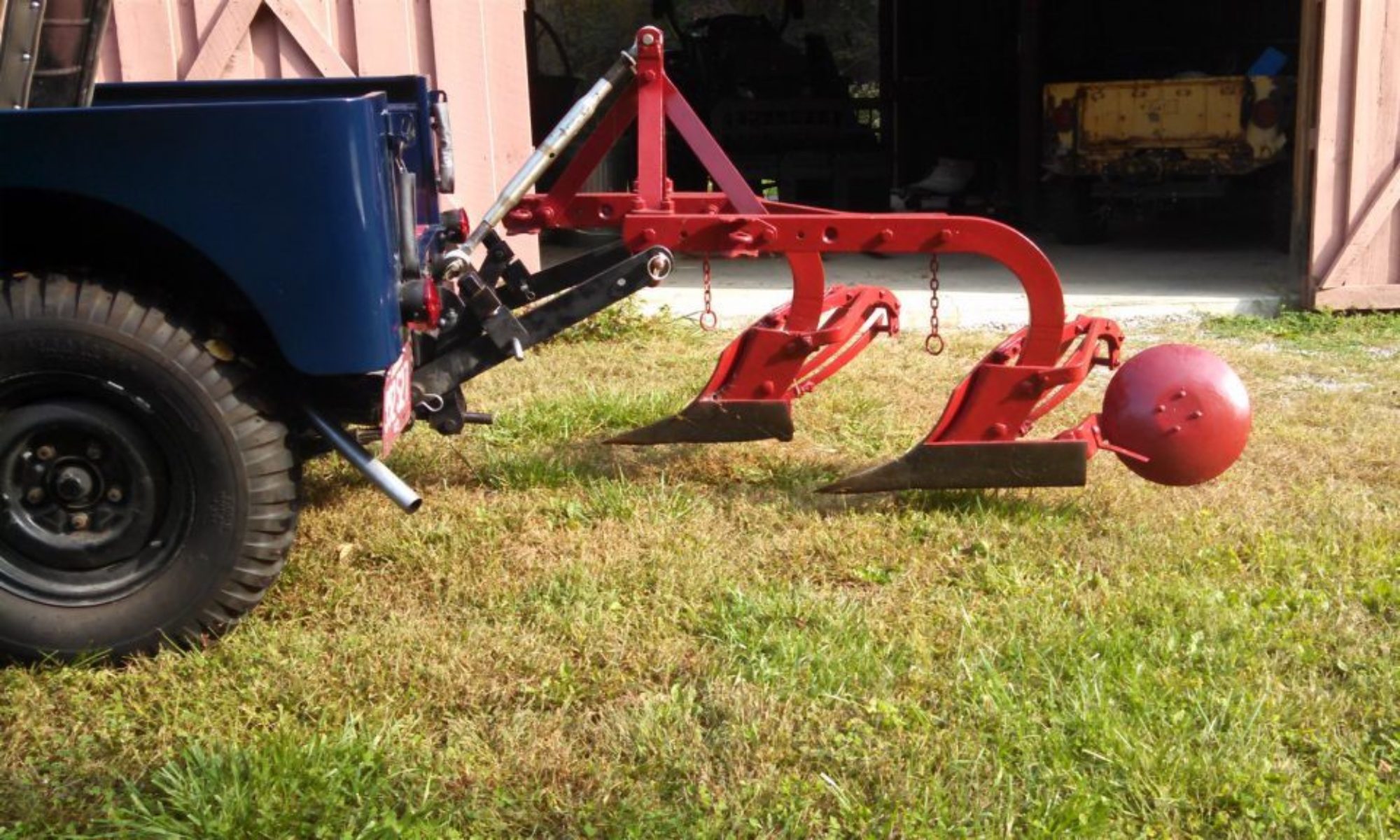
Much of our work on this site documents the engineering Willys invested in to make the Jeep a viable agricultural tractor—governors, hydraulic lifts, and specialized rear power take-offs. That was the primary strategy behind the early Farm Jeep.
The Pepsodent campaign shows that an alternate market existed from day one. Long before the recreational camper and trail-riding marketing common to the 1960s and 1970s, consumers saw the CJ-2A simply as an appealing, go-anywhere vehicle for everyday travel.
Tracking the Winners
The prize structure left an interesting historical footnote: given the choice between a brand-new 1945 civilian Jeep and $1,000 cash, what did winners choose?
We know that at least one winner—Edwin Grossman, a student at Drew University—opted for the $1,000. Pepsodent’s contest rules stated that a full list of winners would be mailed to anyone who sent a stamped, addressed envelope. We are currently searching for a surviving copy of that list to see how many of the twenty winners took the cash and how many drove home in a new CJ-2A.
Updates will follow as research continues.
FJ