
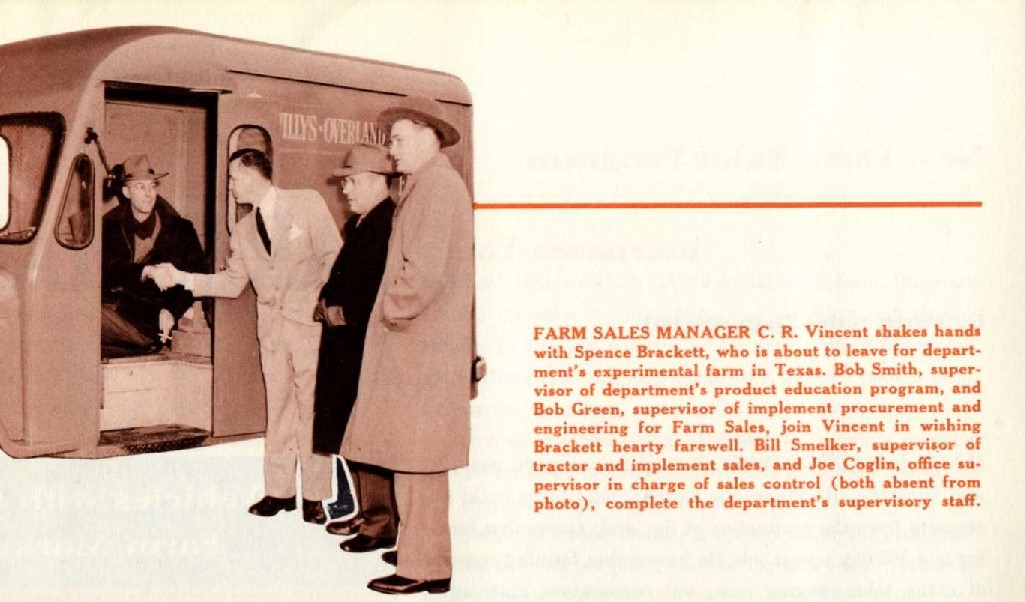
After joining the Willys Farm Sales department, Robert Green appears to have continued to do what he did at Newgren. As shown above, he is listed as the “supervisor of implement procurement and engineering.” Willys introduced the official Farm Jeep model and began to test attachments to ensure they worked properly with the Jeep. New products, including a 3-point hitch-mounted corn picker, were introduced. This one is of particular note since it was photographed being field tested near Bowling Green, Ohio – home of Robert Green.
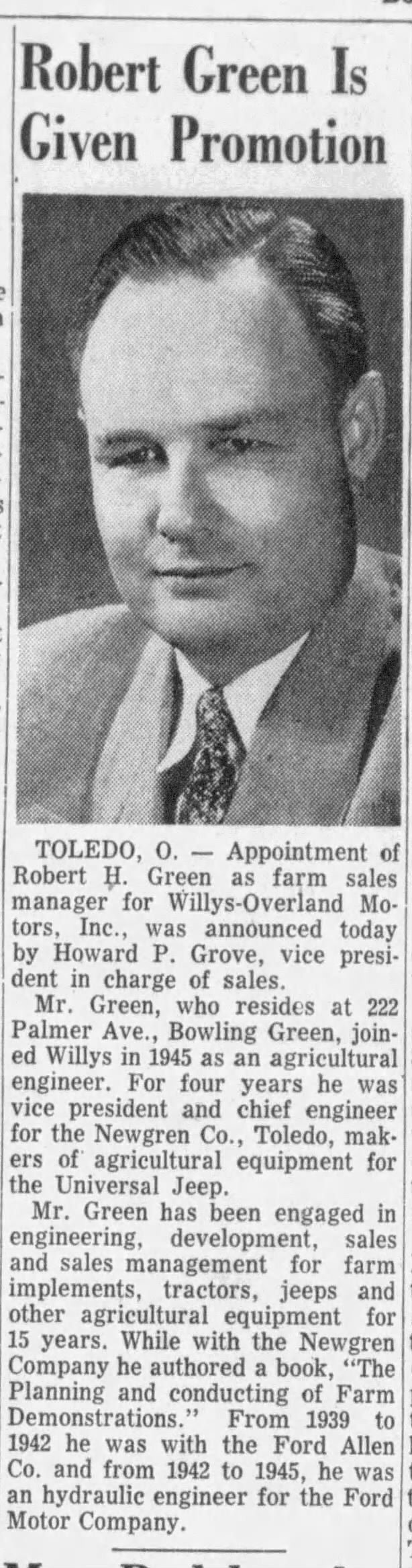
In September 1952, Green was promoted to head the Farm Sales unit and held that position until 1955. The above announcement gave clues to Green’s background. It told us of his early employment, including that Ford employed him as a hydraulic engineer.
Green and the Farm Demonstration
The announcement also noted that Green had “authored a book, “The Planning and conducting (sic) of Farm Demonstrations,” while at Newgren.In the mid-1950s, Willys Motors, Inc. produced a “Product Merchandising Manual” containing forty instruction sections. One section, “Demonstrations,” gives detailed instructions on preparing for and conducting farm demonstrations. Although no copies of Green’s book on the subject have been found, it seems likely that his work was the basis of this section of the manual.
The end of an era
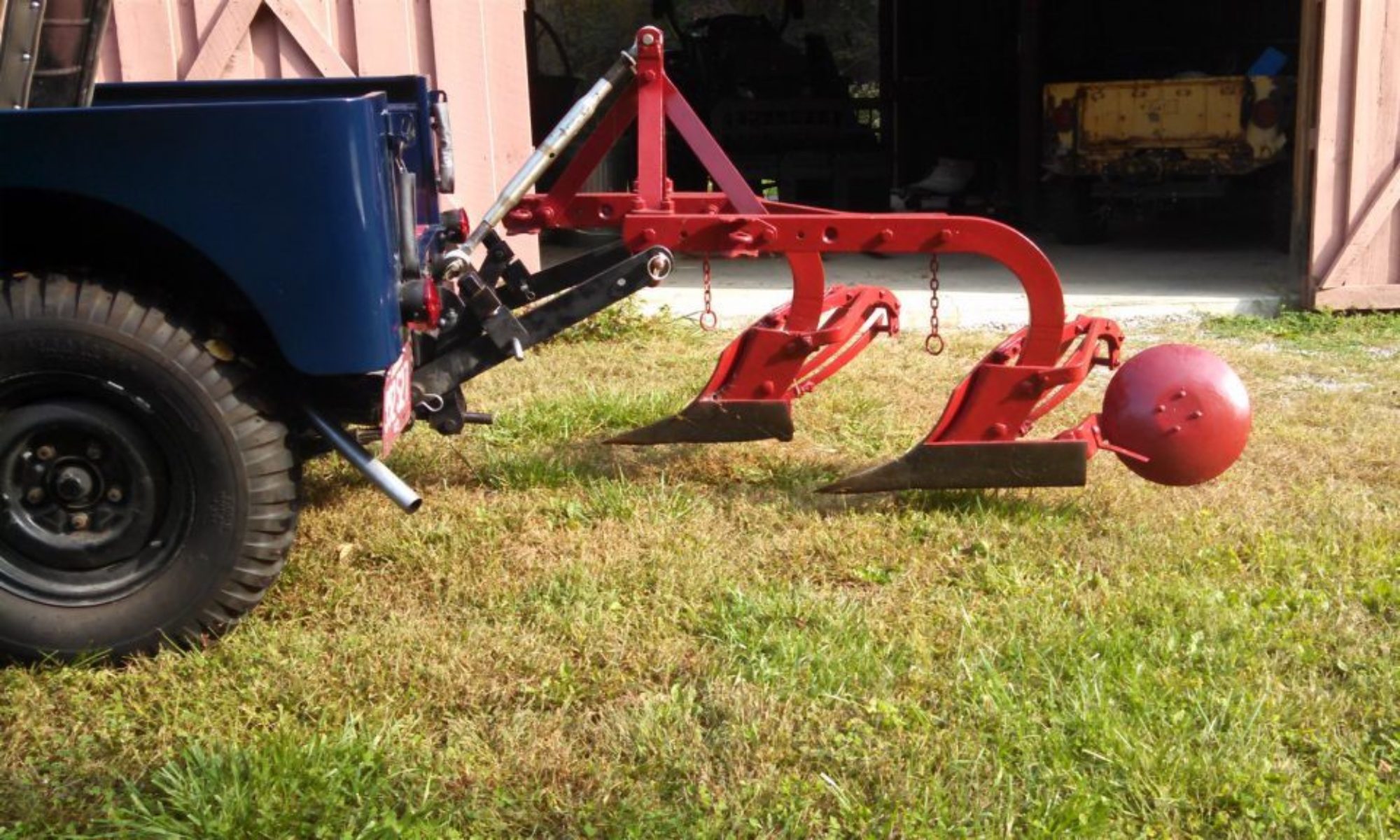
Willys sold four hydraulic lifts. There is direct evidence that Robert Green worked on three of those (Love, Newgren, and Monroe). The fourth, the Stratton lift, was patented in 1962. The patent’s description appears to have been written by someone knowledgeable about the prior lifts and their shortcomings.
Monroe appears to have stopped producing the Jeep lift by the mid-1950s. The most stated date is 1956, although no production records exist for the lifts. Willys would need to find a replacement unit or abandon the farm market completely. That job would have fallen to Green.
Stratton Equipment Company of Cleveland is best known for producing refuse trucks and lifting equipment and making a tailgate lift for the Jeep pickup. Nothing in Stratton’s background indicates they would have entered the farm implement lift business on their own accord. After studying the lift’s patent, we were convinced that someone at Willys had designed it for them.
The pieces fell into place after learning that Green was heading the Farm Sales unit until 1955. In Todd’s interview, Green had stated that he was proud of the Newgren lift and thought it was a better design than the Monroe. First, the Newgren allows you to continue using the bed, and second, it helps to strengthen the frame.
Furthermore, Green would develop a new lift design, similar to the Stratton unit, after leaving Willys. We continue to research Monroe, Stratton, and the Farm Sales unit. Additional facts may emerge to prove us wrong. For now, we believe the Stratton design was as much Robert Green’s as anyone’s.
By the mid-1950s, Farm Jeep sales had slowed considerably. We have no information on why Green left Willys. It is possible that the company disbanded the Farm Sales unit. Or Green may have wished to return to his own company full-time. Historian Keith Buckley has pointed out that Kaiser had taken over the Farm Jeep project by 1955. Either way, Green’s impact on the Farm Jeep appears to have extended into the 1960s.
Part II Green Manufacturing
During this period, Green seems to have continued to conduct his other business operations out of his home.
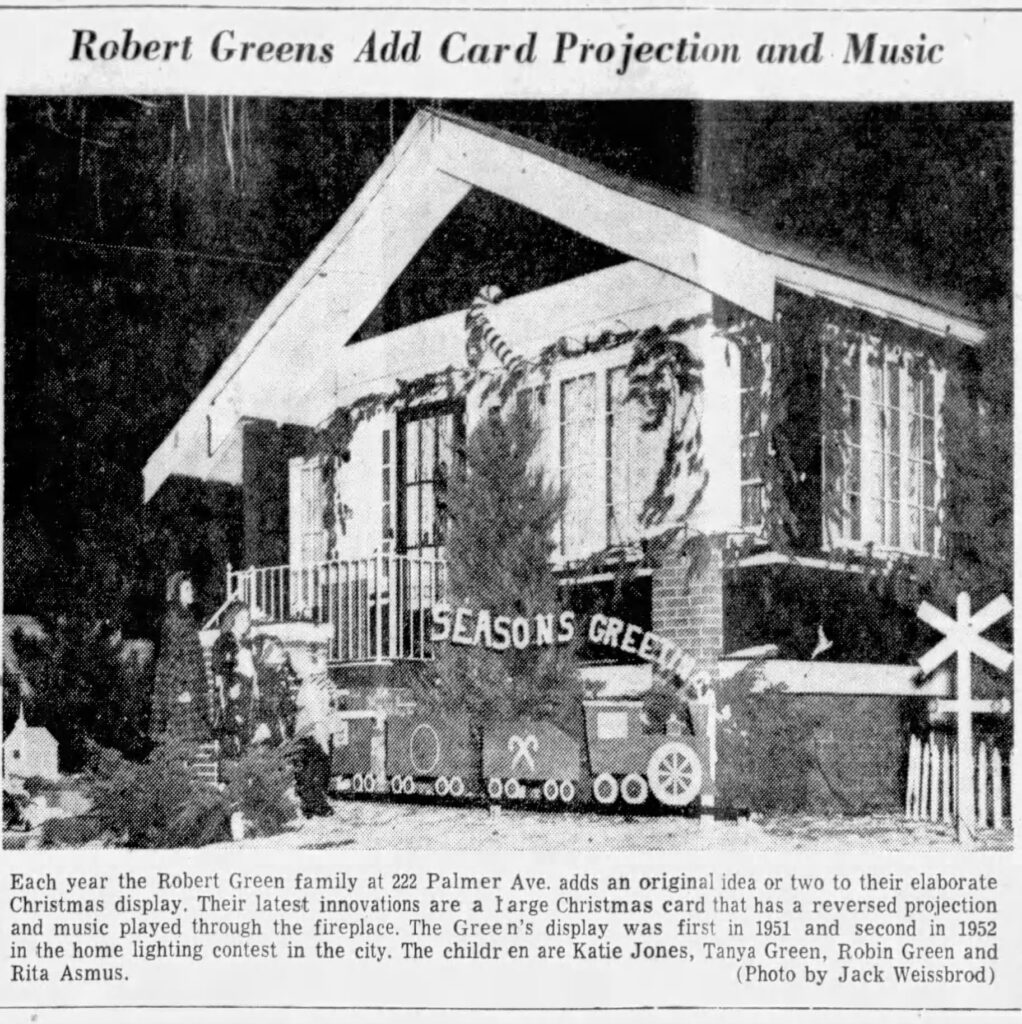
Green’s engineering skills weren’t limited to his work. His Christmas decorations would win community awards on more than one occasion. The company continued to grow; he would continue to run it from his residential address.
Next up, 1956-1968.
Return to the timeline.