
A Conversation
In September 2025, I sent an email to a group of Jeep historians and researchers that I fondly call my Willys Wizards. The email started off discussing a photo I had found of a man testing a CJ2a equipped with a Newgren Lift and working a box blade. At some point in the sixty-two messages that were exchanged, Todd Paisley told us what he had learned from Robert Green in a 1997 interview. I have summarized that part of the conversation below. I have also added my own thoughts on how this both adds to and changes what we know about Robert Green (RG).
Background.
Todd: I interviewed him in April 1997, and for the second follow-up interview, Fred (Coldwell) also participated. The guy was knowledgeable about the various companies that supplied components for Newgren implements, as well as the Monroe people involved. The cool thing for the second interview, he said, he told his wife about the interview and said: “See! Some people cared about what I did.” I think our calling really made his day.
In hindsight, I probably should have asked more follow-up questions. The problem we were having was that he was hard of hearing by that time. We had to constantly repeat the question for him to hear. After the second interview, we discussed a third in-person interview with a video camera. We never did that.
Time at Willys.
Robert Green said he worked for Willys starting in 1944, in the engineering department under Barney Roos. There were about 15 people working on the civilian Jeep development. When Charlie Sorensen left Willys, Willys was still willing to work with him. Robert Green left Willys to form Newgren with George Newlin, who was Charlie Sorensen’s farm manager, based on Charlie Sorensen’s suggestion. Charlie Sorensen was not active in the Newgren company.
We never asked where he worked or if he knew Charlie Sorensen prior to joining Willys.
BT – This is new and important. It tells us that RG arrived at Willys and that he went to work for Roos, not directly for Sorensen.
We did ask when the hydraulic lift was designed, in relation to the CJ-2. He said it was after the CJ-2 was started. We asked about the CJ-1, and he knew nothing about it except that it existed and was in place before he got involved.
He said Willys has very good records of the testing of the Jeep, but how the prototype Jeeps were handled after the testing was “loosy-goosy”. Each of those Jeeps had files based on their X number. He did remember the early CJ-2 with the air compressor.
He also said at the July kickoff meeting that there were no CJ-2As. Just X64 dressed up like a CJ-2A.
The change from agricultural tires to NDTs occurred because “People were thinking about running them more on the road than working them.”
Green seemed knowledgeable about hydraulics. When Fred asked some questions about hydraulics, he said: “You sound like you got some idea of what hydraulics is all about?” When he was saying the Newgren lift’s down pressure was “shit,” he described it, “You see, you can’t take oil and run it through an orifice to control pressure.”
When designing the Newgren lift, Green said there wasn’t any concern on the patents or the designs that Ford had. Newgren never bought anything from Ford, and they had no interface with Ford on their design.
They did consult with the American Society of Agricultural Engineers, but it had no standards. The lift had no way to control depth, unlike the Ford-Ferguson, which could control it via hydraulic pressure. But the Newgren lift could not. It used the implement’s weight. Even though the Monroe lift could adjust the down pressure up to 500 pounds, Robert said, “Yeah, but it wasn’t worth a shit.” He explained that you needed a fixed platform to control the hydraulics and that the problem with the Jeep was that the springs and wheels got in your way. A tractor like a Ford-Ferguson didn’t have any springs. They tried to block the springs on the Jeep, but it would just tear up the frames. Robert said, “The jeep frames were very strong for what they were built for, but they weren’t worth a shit for a farm job.”
BT – This is the key reason the Jeep performed so poorly as a tractor.
Monroe designed and built the hydraulic pump on the front of the engine.
BT – This is very important new information. The front pump and bracket were used on the Newgren, Monroe, and Stratton lifts.
The King-Seeley governor was replaced by the Monarch and Novi governors due to cost.
Monroe supplied the hydraulic cylinder for the lift. They sold around 300 lifts. It was last sold in 1947.
BT – This is very important new information. 300 lifts are a very small number compared to the thousands (?) of Monroe lifts sold.
(Todd was asked if Green said much about Jabez Love) He was only there until 1945. According to Green, when Sorensen left, Willys was still willing to work with Love. I am assuming this is from an engineering perspective. From the discussion, it appears that the engineers from Willys and Monroe were close.
BT – Love was strictly an outsider.
Green did mention Love. He said they built 2 or 3 prototypes (different versions) of a hydraulic lift for the Jeep, but they were never successful and only appeared in the equipment manual. When asked about that entry in the equipment manual, he stated it was just a photo of the development unit. He did say there were Love plows. Not sure why he was saying Love never made a lift.
BT – RG would have been eighty-three at the time of the interview. Not unusual that he would get facts wrong.
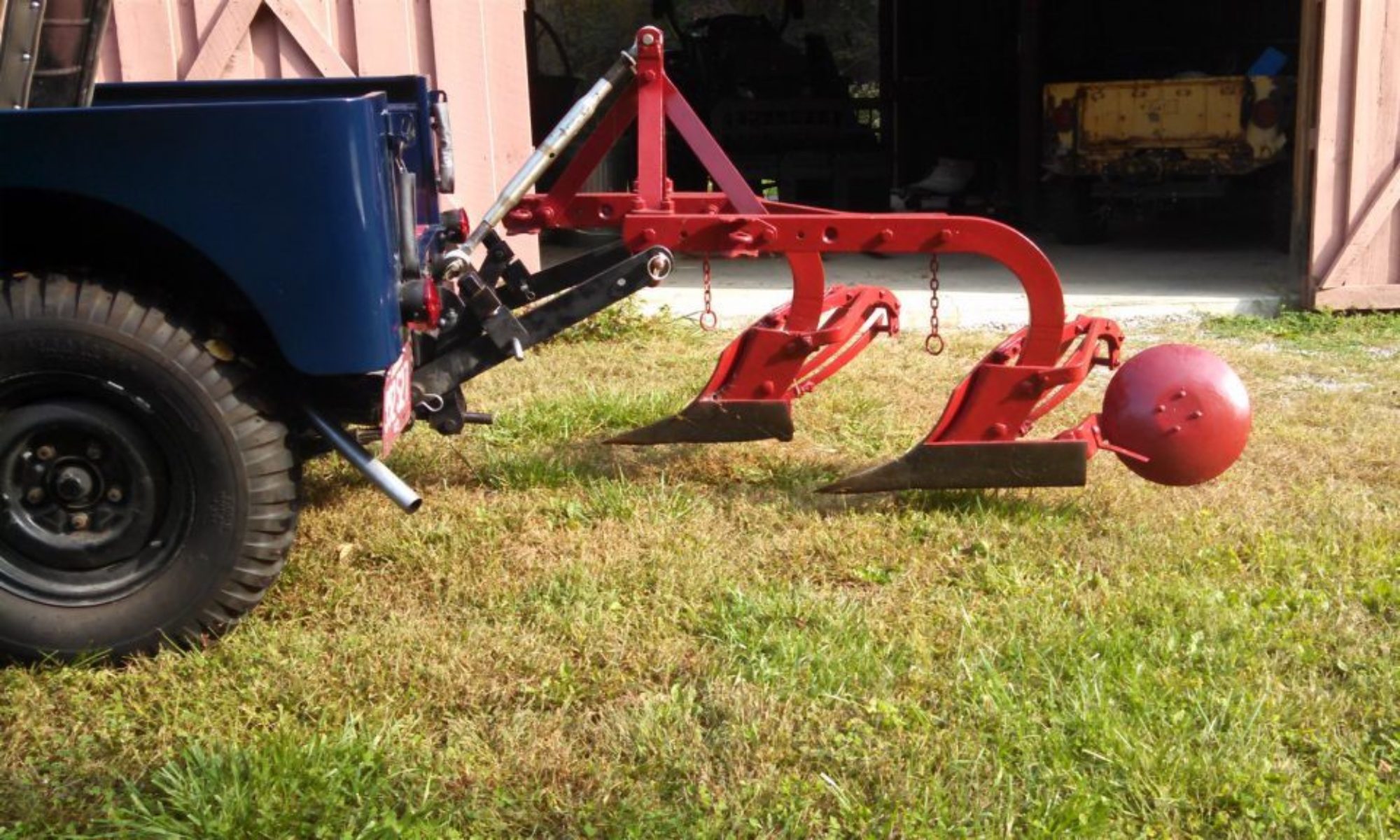
He was proud of the Newgren lift and thought it was better than the Monroe one because it let you continue using the bed. The added bonus was that it strengthened the frame.
BT – This strengthens my position that RG wrote the patent description for the Stratton Lift.
When asked whether the Newgren lift had any problems with dirt getting up on the cylinder due to its location, compared with the Monroe design, he said no.
There was some discussion regarding Empire Tractor. When asked if there was any connection between the people who did the Empire tractor and Willys-Overland, he said, “A little friendship…. That’s all.” He said that, besides the cost compared to Ford, they had a lot of problems. One of these was with work speeds. They couldn’t get down slow enough.
Time at Newgren
Newgren’s business model was to use Willys dealerships to sell their products. 20% of Willys dealers were agricultural implement dealers early on. They would set up areas at trade shows and county fairs for local dealers to showcase their products in action. They were the ones who produced the film “Revolution in Pleasantville”.
BT – Important information for the dealer section. Monroe, not Newgren, produced the movie. Monroe produced a similar movie for the Dodge Power Wagon, showcasing the Monroe lift for that vehicle and using Newgren implements. There is speculation that one or two of the McIntrye brothers make cameo appearances in the movies.
Green said the highest number of people that Newgren ever employed was 25. And they just sold through Willys dealers.
Green was fairly knowledgeable about the various companies that supplied components for Newgren implements, as well as the Monroe people involved.
Robert Green said that the implements were all built by outside suppliers. For the plows, Farm Tools built the bottom, and Monroe built the frame based on a design from Newgren. He said Farm Tools was located in Mansfield, OH. Later on, they subcontracted the frame’s production to a company in Canada whose name he couldn’t remember.
The buzz saw was supplied by Bullard.
The body extension was the first product released by Newgren. It was built by “a continental bending shop in Detroit”. The body extension was the most successful Newgren product, with around 20,000 units sold.
BT – Interesting information
We asked multiple times about the model numbers of the Newgren products and whether they were related to the companies from which they were sourced, but he didn’t know.
BT – Early on, there is a pattern in model numbers and sources. More trivia than useful.
Some of the literature says that Newgren plows were “Farm Tested”. Those were tested at Sorenson’s farms. And Monroe Auto Equipment farms in Monroe, MI. And a farm in Georgia.
BT – The “Farm Tested” was part of Monroe’s campaign. There is an interesting story about the Jeep Test Farm in Georgia.
When we asked him if he had any information about the company, he said all of those records went to Monroe. He didn’t even have a brochure or ad. Fred sent him copies of some things, including his book.
BT – All useful information, and why so little paper trail. The Bantam suit almost ruined Monroe. That was when they washed their hands of the whole Jeep business.
He seemed to be more of an engineer than a manager.
BT – True. I believe George Newlin was the managing half of the team.
Monroe bought out Newgren, and Robert Green continued on with Monroe. The person pushing for the Monroe deal was the chief engineer of Monroe at the time, with the last name of Smith.
BT – Here is where the McIntyre brothers come into play. Compare this Monroe Hydraulic Lift History by Jerry Wittkop to Clint Dixon’s The Making of the Farm Jeep – Part 3
What Robert Green said is that Bantam was purchased to resolve the ongoing FTC complaint over who had the first Jeep and the attempt to trademark the Jeep name.
BT – Interesting because it was Willys, not Monroe, that was fighting with Bantam over the Jeep name.
A Special Thank You
Jeep historian Todd Paisley conducted and recorded telephone interviews with Robert H. Green in the 1990s. Todd’s preservation of Green’s firsthand engineering recollections provides a rare primary source that significantly increases our understanding of the Farm Jeep era. His generosity in sharing this material has ensured that an important chapter of early Farm Jeep history is not lost.
Barry